Memory Beyond Memory
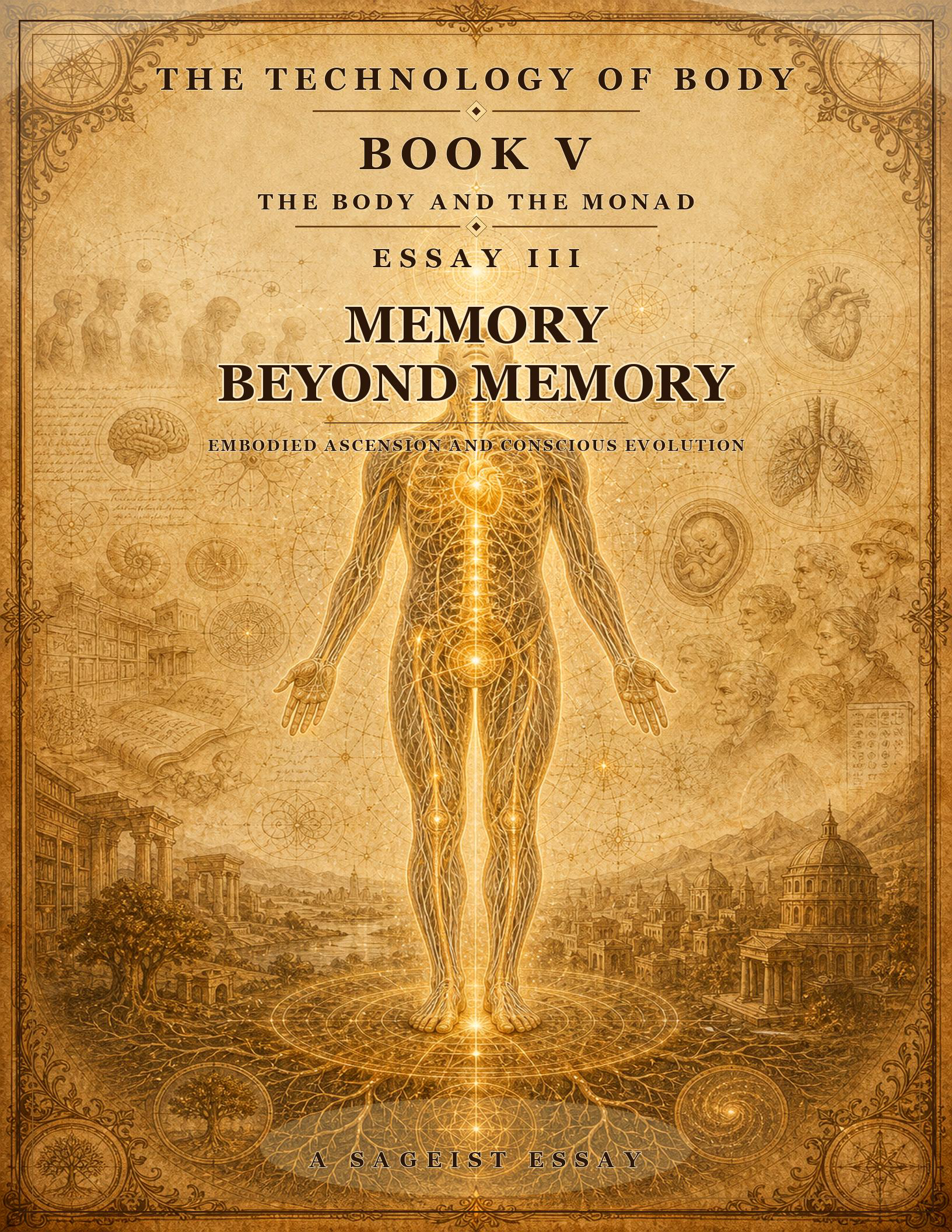
Beneath the remembered event lies the remembered pattern — the body as living archive, through which consciousness remembers itself across biography, ancestry, symbol, and future possibility.
Human beings remember through thought. They recall names, places, injuries, promises, faces, instructions, songs, and stories. Ordinary memory gathers the fragments of experience into narrative so the person can say, this happened, this mattered, this shaped me, this belongs to my life.
But consciousness remembers through deeper structures. Memory exists within language, but not only within language. Memory exists within emotion, but not only within emotion. Memory exists within physiology, but not only within physiology. Beneath the remembered event lies the remembered pattern. Beneath the remembered pattern lies the continuity of consciousness itself.
The Monad carries continuity deeper than biography. It is not merely the owner of memories. It is the center to whom memory appears. Biography changes, but awareness remains the field in which biography is known. A life can lose details and still retain tone. A person can forget an event and still carry its imprint. The body can preserve what the mind no longer narrates.
This is why the body remembers more than the mind can explain. Breath remembers. Muscle remembers. Posture remembers. Skin remembers. The nervous system remembers whether the world was safe, whether love was reliable, whether sound meant danger, whether silence meant peace, whether touch meant care, whether authority meant protection or threat. These memories often live beneath language.
Yet Sageism asks whether memory reaches deeper still. There may exist forms of remembrance beyond ordinary cognition, beyond personal narrative, beyond the usual boundary of the present life. The doctrine does not demand superstition. It asks for disciplined openness. The human being may be more continuous than the personality assumes.
Many experiences cannot be explained purely through present memory. Instinctive attraction. Immediate aversion. Unexplained intuition. Deep familiarity. Sudden recognition. Unconscious capacities. A place never visited can feel known. A person newly met can feel ancient. A symbol can awaken emotion before the intellect understands it. A practice can feel like return rather than novelty.
The modern mind often rushes to reduce these experiences. It calls them coincidence, projection, association, inheritance, pattern recognition, unconscious learning, or imagination. Sometimes this is correct. The Sageist must be sober. Not every feeling is revelation. Not every familiarity is destiny. Not every intuition is truth. The body can know, but it can also distort.
Still, reduction alone cannot exhaust the mystery. Human consciousness contains depths that are not always visible to surface explanation. The psyche is not a flat room. It is a temple with chambers. Some chambers are personal. Some are ancestral. Some are archetypal. Some may belong to the Monad's continuity beyond the obvious borders of biography.
Ancient traditions understood remembrance differently. Knowledge was not always considered invention or acquisition. Sometimes it was recollection. The initiate did not merely acquire truth from outside. The initiate remembered truth already present within consciousness. Initiation was the art of awakening what had become hidden beneath sleep, fear, appetite, distraction, and fragmentation.
This perspective suggests that human life is not merely accumulation. It is remembrance. The child does not only learn how to be human. Something within the child gradually recognizes the world. The student does not only receive knowledge. Something within the student awakens toward pattern. The initiate does not only gain doctrine. Something ancient in consciousness answers.
The body becomes the archive through which deeper memory gradually reveals itself. It carries personal history, ancestral inheritance, emotional pattern, instinctive intelligence, symbolic resonance, and spiritual potential. The body is not a blank surface written upon by life. It is a living manuscript already filled with faint script, waiting for certain experiences to bring the ink forward.
Love awakens memory. In love, the person may recognize a tenderness older than the present relationship. The heart seems to remember a form of belonging it cannot fully name. Love can reveal the difference between appetite and recognition, between possession and devotion, between need and sacred encounter. It teaches the Monad that another center of experience exists.
Suffering awakens memory. Pain can expose patterns hidden beneath ordinary functioning. A wound may reveal old fear. Loss may uncover ancient grief. Betrayal may awaken a depth of vigilance that belongs not only to the event, but to earlier layers of survival. Suffering is not holy because it hurts. It becomes initiatory when consciousness descends into it and remembers what has been split away.
Beauty awakens memory. A landscape, a voice, a temple, a face, a gesture, a painting, a night sky, a mathematical proportion, a piece of music, or the quiet order of a room can produce recognition before analysis. Beauty does not merely please the senses. At its highest, beauty reminds the soul of order. It tells the body that harmony is possible.
Silence awakens memory. When the noise of identity recedes, deeper signals begin to rise. The mind first remembers its unfinished tasks. Then it remembers its wounds. Then it remembers its longings. If the silence deepens, the person may sense a presence beneath all these movements, a continuity not built from thought. Silence allows memory to return from beneath performance.
Initiation awakens memory. A true initiation reorganizes the human being so hidden knowledge becomes usable. It does not insert wisdom into the person like data into a machine. It arranges the body, attention, nervous system, emotion, and symbol so that dormant capacities can appear. Initiation is remembrance made embodied.
The Monad may enter life carrying potentials waiting for activation. These potentials are not fully formed achievements. They are seeds. A person may carry an aptitude for healing, architecture, leadership, music, study, discipline, vision, protection, beauty, or devotion long before the outer life gives that aptitude a name. The seed waits for soil.
The body helps reveal the seed. One practice drains the organism while another wakes it. One environment dulls perception while another gathers it. One relationship fragments the person while another calls forth dignity. One discipline feels imposed while another feels like ancient agreement. The body often knows before the mind understands.
This knowing must be refined. Raw impulse is not the same as deep remembrance. Trauma can masquerade as intuition. Habit can masquerade as destiny. Desire can masquerade as calling. Fear can masquerade as wisdom. The Sageist does not obey every inner signal. The Sageist listens, tests, disciplines, and integrates.
Memory beyond memory therefore requires discernment. The question is not only, what do I feel? The deeper questions are: does this remembrance create coherence? Does it deepen responsibility? Does it increase truthfulness? Does it make the body more present, the heart more honest, the mind more clear, and the life more aligned? False memory fragments. True remembrance orders.
Book I revealed the body as technology. Book II revealed the nervous system as consciousness interface. Book III revealed the body as living symbol. Book IV revealed initiation as transformation. Book V now enters the mystery of the Monad, the continuity of consciousness moving through embodiment. Essay III asks how this continuity remembers.
The answer begins with the body, but does not end there. The body stores personal experience. It also carries ancestral experience through genetic, behavioral, cultural, and symbolic inheritance. A family teaches memory through food, posture, accent, story, silence, worship, suspicion, skill, humor, grief, and fear. The body receives the past before the mind evaluates it.
Ancestral memory does not require fantasy. The descendants of survival inherit more than names. They inherit patterns of vigilance, endurance, migration, scarcity, craft, reverence, anger, beauty, and hope. These patterns are not always conscious, yet they shape appetite, relationship, ambition, shame, trust, and belonging. The body becomes a meeting place of the living and the dead.
The task is not to worship ancestry blindly. Every lineage contains gifts and wounds. To remember beyond memory is not to romanticize the past. It is to become conscious of what the past continues to do through the body. The initiate honors what is noble, repairs what is wounded, refuses what is destructive, and transmits what is refined.
The body can therefore become an altar of transmutation. A pattern of fear inherited through generations may become vigilance in service of protection rather than contraction. A history of grief may become depth rather than despair. A lineage of labor may become discipline rather than exhaustion. A legacy of silence may become contemplative strength rather than repression.
Memory also exists at the level of species. Human beings remember fire, shelter, rhythm, threat, tribe, sky, birth, death, storytelling, dance, hunger, and the face. Some symbols return across cultures because the human body knows certain forms before doctrine explains them. The circle, the tree, the mountain, the serpent, the sun, the cave, the river, the gate, the mirror, and the child carry meanings rooted in embodied experience.
This is why symbols are not decoration. They are memory-forms. A symbol gathers experience too deep for simple definition. It compresses history, instinct, psychology, and metaphysics into a form the body can feel. To encounter a powerful symbol is to encounter condensed memory. The body responds before the intellect finishes speaking.
The Monad may recognize itself through symbol because symbol speaks across levels. It touches sensation, emotion, imagination, thought, and spiritual intuition at once. A purely literal language can inform. Symbolic language can awaken. The sacred manuscript, the temple, the anatomical diagram, the illuminated body, and the inner sun all function as instruments of remembrance.
This is also why ritual matters. Ritual gives memory a body. A vow spoken aloud is remembered differently than a vow only thought. A repeated gesture enters muscle. A candle lit at the same hour trains attention. A breath practice reshapes the nervous system. A pilgrimage engraves the path into feet and spine. Ritual is memory arranged through form.
Modern civilization suffers from ritual confusion. It has not become ritual-free. It has become dominated by unconscious rituals: scrolling, consumption, outrage, comparison, speed, performance, compulsive productivity, emotional avoidance, and technological stimulation. These rituals train memory. They teach the body what to expect from reality.
If the body is repeatedly trained into fragmentation, it remembers fragmentation. If attention is repeatedly scattered, it remembers scattering. If desire is repeatedly exploited, it remembers hunger without satisfaction. If fear is repeatedly stimulated, it remembers danger as identity. Civilization becomes a machine for installing memory into nervous systems.
The future of civilization requires conscious memory design. Education should not merely deliver information. It should awaken remembrance of dignity, attention, beauty, service, self-governance, and relationship. Architecture should not merely house functions. It should remind the body of proportion, silence, orientation, and sacred order. Technology should not merely capture behavior. It should respect the continuity of consciousness.
The doctrine of memory beyond memory transforms education. A teacher is not merely a distributor of content. A teacher is an awakener of latent intelligence. The true teacher recognizes that something in the student is waiting to be called forth. Education becomes less like filling an empty container and more like striking a bell already capable of sound.
This does not mean knowledge is unnecessary. The initiate must study. The body must practice. The mind must be trained. Memory beyond memory is not an excuse for laziness. Seeds require cultivation. Potentials require discipline. A gift not developed remains immature. Remembrance must become craft.
The same principle applies to healing. A therapist, physician, guide, elder, or healer does not place wholeness into a person from outside. They help create conditions in which the person's own organizing intelligence can return. Healing often feels like remembering the body as home, remembering breath as refuge, remembering truth as possible, remembering the self beneath adaptation.
The body may remember safety before the mind trusts it. A steady voice, warm room, gentle rhythm, reliable boundary, patient witness, or honest relationship can teach the organism a new memory. Repetition matters. Safety must become not only an idea but a physiological expectation. The body must learn again that the world is not only threat.
There is also a memory of future. This phrase seems paradoxical, yet the human being often lives toward an image not yet realized. A child senses a calling before form appears. An architect imagines a building before stone rises. A founder senses a civilization before institutions exist. A healer senses wholeness before symptoms resolve. The future calls backward through the imagination.
The Monad may remember not only what has been, but what seeks to become. Potential is a kind of memory held in advance. The oak is not yet visible in the acorn, but the pattern is present. The future human may already exist as a pattern within consciousness, waiting for bodies, disciplines, societies, and technologies capable of expressing it.
This is the deeper meaning of destiny. Destiny is not a rigid script imposed from outside. It is the pressure of latent form seeking expression through life. One can betray it, distort it, ignore it, or refine it. Destiny requires participation. The Monad carries possibility, but embodiment determines whether possibility becomes reality.
The body knows destiny as vitality. When a person moves toward aligned work, the body often awakens. Breath deepens. Attention gathers. Endurance increases. Meaning returns. When a person lives too far from the inner pattern, the body may become dull, anxious, resentful, fragmented, or exhausted. Not every fatigue is spiritual misalignment, but chronic disconnection leaves biological signatures.
The Sageist must read these signatures carefully. The body is not a simple oracle. Illness, stress, environment, poverty, trauma, oppression, and chemistry all matter. To interpret the body symbolically without respecting material reality is error. Yet to treat the body as meaningless machinery is also error. Wisdom holds levels without collapsing them.
Civilization needs such remembrance because cultures can forget themselves. A culture can forget beauty and call it luxury. It can forget wisdom and call information intelligence. It can forget embodiment and call disembodiment progress. It can forget soul and call efficiency civilization. Collapse begins when a society loses memory of what makes human life sacred.
The body becomes a counter-memory. It resists lies. It grows anxious under falsehood, tired under fragmentation, inflamed under excess, numb under violation, and restless under meaningless repetition. Even when the mind adapts to disorder, the body often protests. Symptoms can become the body's refusal to forget truth.
This does not mean every symptom has a simple meaning. The doctrine must remain compassionate. Pain must not be turned into accusation. Illness must not be moralized. Suffering must not be spiritualized into blame. But the body deserves to be listened to because it may be carrying memory that has not yet found language.
Memory beyond memory is also felt in moments of deja vu, deep recognition, or uncanny familiarity. These experiences should be handled gently. Their value may not lie in proving some metaphysical theory. Their value may lie in the way they open the person to continuity. They remind the ego that the present self is not the whole of consciousness.
The Monad is not bound by the ego's timeline in the same way the personality is. The personality says, I began here, I became this, I remember that, I desire this, I fear that. The Monad witnesses the timeline. It moves through time without being reducible to time. Memory beyond memory points toward this deeper continuity.
This continuity changes how one lives. If the self is more than immediate mood, then mood need not rule. If the body carries old memory, then compassion becomes necessary. If ancestry moves through the present, then repair becomes sacred. If future potential calls through the present, then discipline becomes devotion.
Ethics emerges from memory. To harm another is to install memory into their body. To love another is also to install memory. A child remembers the tone of a room. A partner remembers whether truth was safe. A student remembers whether their dignity was seen. A community remembers whether power protected or exploited. Every action becomes part of the archive of the world.
The Sageist therefore acts carefully. Words are not merely sounds. They become memory in another nervous system. Touch is not merely contact. It becomes memory in another body. Leadership is not merely decision. It becomes memory in institutions. Architecture is not merely structure. It becomes memory in those who inhabit it.
The body is the nearest archive, but civilization is also an archive. Streets, laws, monuments, schools, rituals, technologies, songs, diets, myths, calendars, and economies store memory. A society teaches people what to remember by what it repeats. It teaches people what to forget by what it neglects. Culture is collective memory in motion.
The restoration of civilization will require a restoration of sacred memory. Not nostalgia. Nostalgia freezes the past. Sacred memory extracts wisdom from the past so the future can be built with soul. The Sageist remembers ancient forms not to imitate them mechanically, but to recover the principles they carried: proportion, initiation, reverence, coherence, beauty, service, and self-governance.
Death asks the final question of memory. What remains when the body returns to earth? What does consciousness carry? What has been integrated? What has been transmitted? What lives in those touched by one's presence? The body ends, but the memory installed through love, work, teaching, harm, repair, beauty, and example continues in the living field.
Perhaps the Monad carries more than the mind can prove. Perhaps consciousness retains impressions that ordinary thought cannot access. Perhaps life is less a closed line than a spiral of remembrance, encounter, forgetting, and return. The doctrine does not need premature certainty. It requires reverence before the mystery.
Book V deepens here: the incarnate human is not only a body inhabited by consciousness. The incarnate human is a living archive through which consciousness remembers itself. Some memory belongs to the mind. Some belongs to the body. Some belongs to lineage. Some belongs to symbol. Some belongs to the future. Some may belong to the Monad.
Essay III closes with this recognition: the purpose of life may not simply be learning new information. It may be remembering what consciousness already contains, then embodying that remembrance with discipline. The body remembers more than the mind can explain, and memory itself may reach far beyond the boundaries of ordinary thought.
The gate closes here: remembrance is not escape from the present. It is the deepening of presence through continuity. The Monad remembers through body, symbol, ancestry, beauty, suffering, silence, love, initiation, and future possibility. To remember beyond memory is to become faithful to the hidden archive within the living human form.